http://www.cbc.ca/news/business/story/2012/08/10/cpp-fund-up.html
The Chief Actuary of Canada said the CPP will remain sustainable for at least the next 75 years, and says that contributions are expected to exceed benefits paid until 2021. That means CPP won't need to dip into its investment returns for the next nine years...
The Canada Pension Plan Fund ended the first quarter of the fiscal year with $165.8 billion in assets, a $4.2 billion increase since the previous quarter.
Canada's national pension plan received $3.5 billion in contributions and earned $800 million on its investments. Its portfolio returned 0.5 per cent for the quarter.
---------------
D - a far cry from $250 billion prediction for in four more years. That was the prediction BEFORE the great economic crash of the last few years.
And 2021 is when the Boomers retire in earnest, in increasing numbers.
Even something as simple (and costly) as widely prescribed statins can completely skew demographic predictions in a hurry.
The above CBC story is NOT good news.
Trying to be positive about that news is like re-arranging deck chairs on the Titanic. The iceberg has already struck us. We just are not quite drowned yet.
And the lifeboats are only numerous enough for first class customers - the Boomers.
Sunday, August 12, 2012

Wednesday, July 25, 2012
my residence ownership plan. pretty modest.
D - so here I am. Age 41. 3 years out of a bankruptcy on my student loan. I have finally reached the income level that is average for - wait for it- the average of both full and part-time work in Canada. About half the full-time average. I still need to rebuild my credit (finally have savings for a secured credit card).
Assuming I get my SH*T together in the next year (working MS office certs through an adult school in town), and get into some decent admin work (databases are a hot job skill at local U campuses - the older secretaries can't do it), I can manage a nest egg in the next few years.
If I try to buy a standard house (suburb, big enough to pass primary residence rules of the OBC - Ontario Building Code), the plan must be as follows:
1) save 5 years for the house downpayment, to age 46,
2) pay the house mortgage 25 years to own it, to c. age 72.
At age 72, as the OAS rules stand, I max out my payout. I need to find work I can keep doing to age 72. At 41, I'm already aware of the impact of age on my body.
On my own, if I end up without a significant other, this is the best case scenario to own my primary residence and enjoy a decade or two of well-deserved rest at the end.
My OTHER plan is much more unorthodox, and likely more reasonable. Basically, it's a trailer park but with a twist.

D - that's a Kottage RV, made by that B.C. company. It's a converted shipping container, so you know it's gonna LAST. Those things are tough! It folds up to fit on a standard transport truck trailer. Then opens up to standard trailer dimensions.
I priced them out, and found a small and medium one used for $45 and $60G respectively.
D - here is a more advanced and spacious version of this concept, made for the USA gov't by "Green Horizons" to be emergency off-the-grid shelter for an emergency.
http://www.greenhorizonmfg.com/products/rapid-response/sfh40-2
The SFH-40 (A is off grid, B is basic) opens up the entire side to nearly double the area. But it still fits IN a transport truck standard trailer. That means no special escort vehicles, rare and expensive oversize trailers and road special rules.


Assuming I get my SH*T together in the next year (working MS office certs through an adult school in town), and get into some decent admin work (databases are a hot job skill at local U campuses - the older secretaries can't do it), I can manage a nest egg in the next few years.
If I try to buy a standard house (suburb, big enough to pass primary residence rules of the OBC - Ontario Building Code), the plan must be as follows:
1) save 5 years for the house downpayment, to age 46,
2) pay the house mortgage 25 years to own it, to c. age 72.
At age 72, as the OAS rules stand, I max out my payout. I need to find work I can keep doing to age 72. At 41, I'm already aware of the impact of age on my body.
On my own, if I end up without a significant other, this is the best case scenario to own my primary residence and enjoy a decade or two of well-deserved rest at the end.
My OTHER plan is much more unorthodox, and likely more reasonable. Basically, it's a trailer park but with a twist.

D - that's a Kottage RV, made by that B.C. company. It's a converted shipping container, so you know it's gonna LAST. Those things are tough! It folds up to fit on a standard transport truck trailer. Then opens up to standard trailer dimensions.
I priced them out, and found a small and medium one used for $45 and $60G respectively.
D - here is a more advanced and spacious version of this concept, made for the USA gov't by "Green Horizons" to be emergency off-the-grid shelter for an emergency.
http://www.greenhorizonmfg.com/products/rapid-response/sfh40-2
The SFH-40 (A is off grid, B is basic) opens up the entire side to nearly double the area. But it still fits IN a transport truck standard trailer. That means no special escort vehicles, rare and expensive oversize trailers and road special rules.

D - the fancy pants zombie apocalypse version costs c. $200G, or may cost as little as $100G or so with economies of scale. The "B" version is presumably considerably less, though would require a standard trailer park connection to be habitable.
D - here is the "thought experiment" that got the ball rolling on this pop-out portable house concept: http://assets.inhabitat.com/files/lt_mdu1.jpg

http://inhabitat.com/lot-ek-shipping-container-house/ The LOT-EK MDU unit.
D - while very nifty, this never reached production.
There are also many concepts based on flat-pack or pop-out 20' shipping containers, such as the ECO-POD.
D- so why bother?
1) they can function as a standard trailer at a trailer park,
2) plunk it down sans wheels /trailer on a concrete pad and you have a permanent residence,
3) upgrading or buying the "A" version allows off-the-grid living.
Keep in mind it takes a transport truck to move these. The 20' units can likely be towed by just a big pickup truck, 3/4 or 1 ton models.
D - I'm a handy guy. I had planned to co-build houses with my bud a few years back. I (I know- funny) helped him build a submarine hull, so torch cutting and MIG welding is doable. Not right now, but down the road, I could buy a $500 bux beater unit of 8x20' to experiment upon. I can check out the existing products on the market and copycat them.
http://toronto.kijiji.ca/c-cars-vehicles-RVs-campers-trailers-cargo-utility-trailers-40-converted-Insulated-Shipping-Container-W0QQAdIdZ386089407 Here are some boxes that were converted for the 1976 Olympics. Ack - claustrophobic!
Port-a-mini and BigSteelBox look like promising local ops to check out.
That's right- my only own-a-house plan that does not involve working to age 72 involves living in a big converted steel box.
My bro-in-law suggested I lease a lil' corner of some old farmer's property near the edge of whatever city I work in. This has issues, such as needing water and septic and power system and so on. 12V trailer appliances are likely a must, as well as very modest and "green" style of living.
D - and I don't even have kids - could not afford them anyway, nor take care of them myself.
D - there is some chance that I might meet (or have met?) a woman that I could live with. 2 incomes turns the equation around in a hurry. Being middle-aged with no savings and no house is a pretty grim scenario to be stuck in.
Living in a trailer park for the 2nd half of my working life might be the only practical way to retire otherwise.
last-minute money grab,Boomers want a CPP bump
http://www.theglobeandmail.com/globe-investor/personal-finance/retirement-rrsps/rob-carricks-reader-the-retirement-income-crisis-ahead/article4440035/
The retirement income crisis ahead
A tough-minded and smart take on how financially unprepared people are for retirement. This is a New York Times piece, but it’s relevant to our Canadian situation as well. All in all, it offers a strong argument for enlarging the Canada Pension Plan to provide a greater piece of the retirement savings that people will need.
http://www.nytimes.com/2012/07/22/opinion/sunday/our-ridiculous-approach-to-retirement.html?_r=3
Seventy-five percent of Americans nearing retirement age in 2010 hadless than $30,000 in their retirement accounts. The specter of downward mobility in retirement is a looming reality for both middle- and higher-income workers. Almost half of middle-class workers, 49 percent, will be poor or near poor in retirement, living on a food budget of about $5 a day.
----------
D - coupla things here. Other than the "working poor", which are actually BELOW middle class, this is a case of Aesop's fable of the ant and grasshopper. Why shouldn't middle class retirees take a hit in living standard, if they don't save? It means they were living beyond their means. Besides, if they retire owning a house, they both lower their operating costs as well as having a flexible nest egg to fall back on.
----------
To maintain living standards into old age we need roughly 20 times our annual income in financial wealth. If you earn $100,000 at retirement, you need about $2 million beyond what you will receive from Social Security. If you have an income-producing partner and a paid-off house, you need less. This number is startling in light of the stone-cold fact that most people aged 50 to 64 have nothing or next to nothing in retirement accounts and thus will rely solely on Social Security.
----------
So somebody who is middle class would need to save MILLIONS throughout their working career. Ideally, they'd begin to save as soon as they graduate from school. Student debt, kids and house mortgages preclude that more than ever today. Student debts are bigger than ever. House mortgages are much more expensive for the young today. And the cost of raising a kid needs to consider the ever-higher tuitions that have already hammered so many young parents.
D - so where is the generational twist in this?
----------
So it’s not surprising that denial dominates my dinner conversations, but it is irresponsible for Congress to deny that regardless of how much you throw 401(k) advertising, pension cuts, financial education and tax breaks at Americans, the retirement system simply defies human behavior. Basing a system on people’s voluntarily saving for 40 years and evaluating the relevant information for sound investment choices is like asking the family pet to dance on two legs...
As we all know, these abilities are not common for our species. The current model for retirement savings, which forces individuals to figure out a plan for their retirement years, whether through a “guy” or by individual decision making, will always fall short.
---------
D - that's right. Boomers, the first ME generation, cannot be blamed for eating the seed corn of the younger generations. Their selfishness is just 'human nature' - and you cannot blame them for that, right?
-------
The retirement income crisis ahead
A tough-minded and smart take on how financially unprepared people are for retirement. This is a New York Times piece, but it’s relevant to our Canadian situation as well. All in all, it offers a strong argument for enlarging the Canada Pension Plan to provide a greater piece of the retirement savings that people will need.
http://www.nytimes.com/2012/07/22/opinion/sunday/our-ridiculous-approach-to-retirement.html?_r=3
Seventy-five percent of Americans nearing retirement age in 2010 hadless than $30,000 in their retirement accounts. The specter of downward mobility in retirement is a looming reality for both middle- and higher-income workers. Almost half of middle-class workers, 49 percent, will be poor or near poor in retirement, living on a food budget of about $5 a day.
----------
D - coupla things here. Other than the "working poor", which are actually BELOW middle class, this is a case of Aesop's fable of the ant and grasshopper. Why shouldn't middle class retirees take a hit in living standard, if they don't save? It means they were living beyond their means. Besides, if they retire owning a house, they both lower their operating costs as well as having a flexible nest egg to fall back on.
----------
To maintain living standards into old age we need roughly 20 times our annual income in financial wealth. If you earn $100,000 at retirement, you need about $2 million beyond what you will receive from Social Security. If you have an income-producing partner and a paid-off house, you need less. This number is startling in light of the stone-cold fact that most people aged 50 to 64 have nothing or next to nothing in retirement accounts and thus will rely solely on Social Security.
----------
So somebody who is middle class would need to save MILLIONS throughout their working career. Ideally, they'd begin to save as soon as they graduate from school. Student debt, kids and house mortgages preclude that more than ever today. Student debts are bigger than ever. House mortgages are much more expensive for the young today. And the cost of raising a kid needs to consider the ever-higher tuitions that have already hammered so many young parents.
D - so where is the generational twist in this?
----------
So it’s not surprising that denial dominates my dinner conversations, but it is irresponsible for Congress to deny that regardless of how much you throw 401(k) advertising, pension cuts, financial education and tax breaks at Americans, the retirement system simply defies human behavior. Basing a system on people’s voluntarily saving for 40 years and evaluating the relevant information for sound investment choices is like asking the family pet to dance on two legs...
As we all know, these abilities are not common for our species. The current model for retirement savings, which forces individuals to figure out a plan for their retirement years, whether through a “guy” or by individual decision making, will always fall short.
---------
D - that's right. Boomers, the first ME generation, cannot be blamed for eating the seed corn of the younger generations. Their selfishness is just 'human nature' - and you cannot blame them for that, right?
-------
In March, according to the Employee Benefit Research Institute, only 52 percent of Americans expressed confidence that they will be comfortable in retirement. Twenty years ago, that number was close to 75 percent.
I hope that fear can make us all get real.
------
(I DID post that as plain text. POS Google blogger... grr.)
D - perception is NOT reality. For example, the demographics most at risk of violent crime are least afraid of it and v.v..
Fear is not reality. So: so what.
------
D - so what is the problem? Boomers and politicians currying favour with them suggest a sudden no-plan bump in retirement income from pensions. Lord forbid if the generation that exemplifies Aesop grasshopper accept a decrease in their short-sighted, unsustainable standard of living! There are plenty of young ants to be parasites on!
First the Boomers pay only a few measly % of their income for the 1st half of their working careers. GenX paid the higher rate, almost 10%, for their WHOLE working lives. The sins of the father- unbalanced accounting legs of the Boomer and the pension plan - are visited on the son. And the son's son, unto 3 generations.
Now, as CARP has been pushing for, they want a last-gasp money grab just before the Boomers retire, so they need not pay more than a pittance for a few years to gain decades of increased payouts.
D - this is GENERATIONAL theft. It's eating the seed corn. It's the older grasshoppers enslaving the entire colony of young ants.
And it is WRONG. It is UNFORGIVABLE to even suggest.
This policy platform will get much play for the next decade or two.
We need to be READY.
D.
Tuesday, June 26, 2012
chile is tuition's "not as bad as Hitler" retort
http://www.theglobeandmail.com/commentary/editorials/quebec-student-protesters-should-look-to-chile-for-a-little-perspective/article4226011/
But there’s good reason for the Chilean students to make noise. In Quebec, there isn’t.
Students in Chile pay roughly $3,400 a year in university tuition, in a country where the average household income is $8,500. For Quebeckers to pay the same proportion, their tuition fees would have to be $25,000. Instead, they pay $2,500 a year. In other words, for every dollar paid by a Chilean student and his or her family, Quebec students pay 10 cents.
And Chile is one of the world’s most unequal societies.
---------
Funny - I'd opine that the BEST time to 'make noise' is wayyy BEFORE Chile's scenario.
Swell - it could be worse.
Now let's look at the OTHER end of this continuum, for context.
------------------
D - a summary of cheap European universities.
Shocking as it may seem to many Canadians, Norweigians don’t charge any tuition to anyone—which was, until recently, normal in Scandinavia. Now, Denmark, Finland and Sweden all charge tuition fees, leaving Norway the only free option.
----------
D - at some point, high tuition renders a degree simply not worthwhile.
D - A bachelor's degree just isn't what it used to be.
D - coupla thoughts:
1) In the USA, gone are the days when a student could use part time and summer jobs to graduate debt-free. In Ontario, I'd earn c. $10,000 per year this way. That assumes c. min. wage, 20hrs/wk for 8mo, and 40hrs/wk for summer.
2) I DO like the idea of students paying SOME tuition. Say about 10% of costs - even less than Quebec. Many will object this is a merely token amount that serves no purpose.
Not true - the literacy group I'm a trained tutor for charges the students for the cost of materials. Why? It gives the students ( or "learners") a vested interest - a stake. Same reason we toss them back to the start of the line-up if they don't attend.
BC offers interest relief - on sky hi rate!
http://www.theglobeandmail.com/news/british-columbia/clark-relaxes-student-loan-repayment/article4370350/
Premier Christy Clark says she’ll ease loan payments for students in British Columbia – in some cases forgiving further payments – as the third pillar of her Families First agenda.
-----------
D - but BC charges the HIGHEST interest rate of any province: prime +2.5%.
So thanks for NOTHING.
-----------------
BC: the cowboy wearing the black hat!
--------------
http://m.theglobeandmail.com/news/british-columbia/the-crushing-weight-of-student-debt/article625694/?service=mobile


Hope you don't plan to get your PhD on student loans:
---------
Premier Christy Clark says she’ll ease loan payments for students in British Columbia – in some cases forgiving further payments – as the third pillar of her Families First agenda.
-----------
D - but BC charges the HIGHEST interest rate of any province: prime +2.5%.
So thanks for NOTHING.
-----------------
BC: the cowboy wearing the black hat!
--------------
http://m.theglobeandmail.com/news/british-columbia/the-crushing-weight-of-student-debt/article625694/?service=mobile
The situation is so critical that, in British Columbia, the heads of four of the province's leading research universities appealed to the provincial government to do something to alleviate the financial stress B.C. students are facing.
B.C. currently charges the highest interest rates on student loans of any jurisdiction in the country - 2.5 per cent above prime. (That compares with Newfoundland, which eliminated interest rates on student loans in 2009.) Worse, B.C. eliminated its student grant program in 2004 and replaced it with a loan-reduction program that forgives millions in debt each year but only for students with certain degrees and who are willing to work in certain areas of the province.
In B.C., interest begins accumulating on a student's debt right after studies are completed. Other provinces have a six-month grace period before this occurs, giving students a chance to establish themselves in a job before their higher loan payments begin. The university bosses would like to see the province adopt a grace period and reduce the interest rate from its current level.

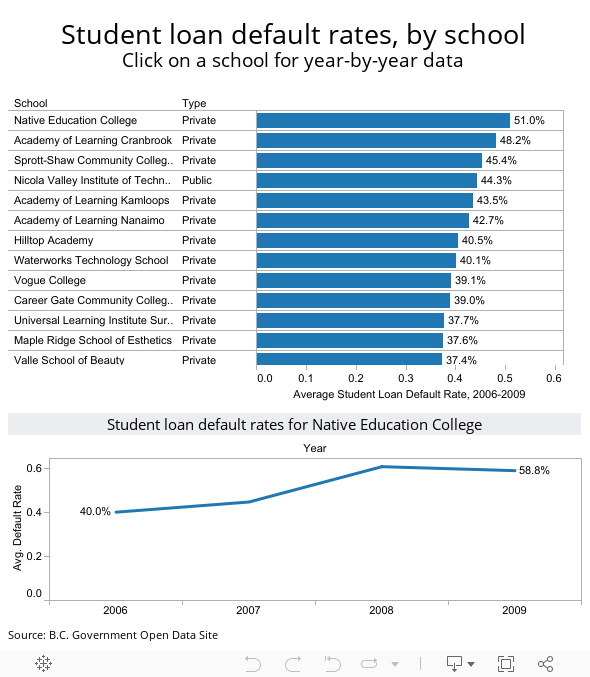
The presidents believe, rightly, that the high cost of financing a postsecondary education is scaring away students from underrepresented groups such as aboriginals and others from impoverished backgrounds. But costs are scaring away kids from middle-class homes as well. And the loans needed to finance those costs are making life miserable for kids trying to get a toehold in a job market that's as unfriendly as they come.
Hope you don't plan to get your PhD on student loans:
---------
Government loans
Canadian citizens, permanent residents of Canada living in any province for over a year, and protected persons[1] are normally eligible for loans provided by the federal government, through the CSLP, in addition to loans provided by their province of residence.
Loans issued to full-time students are interest free while a student is in full-time studies. Students receiving a Canada Student Loan (CSL) for the first time on or after August 1, 1995, are eligible for up to 340 weeks (~6.5 years) of interest-free assistance. Students in doctoral programs are eligible for an additional 60 weeks, up to 400 weeks (~7.5 years). Students with permanent disabilities and students who received their first CSL prior to August 1, 1995 are eligible for up to 520 weeks of assistance (10 years).[2]
As the length of North American graduate degree programs often exceed this 400 week maximum, students considering graduate study are advised to think carefully before taking out student loans. For example, an honours BA from a Canadian University takes four years, assuming satisfactory progress. MA programs in Canada vary in length from 1-3 years, with two years being the average minimum. A PhD, takes on average, 5 years to complete, although many students take significantly longer than this. Assuming a graduate student completes an honours BA (5 years), an MA (2 years), and a PhD (5 years), one can expect to be in university for at least 12 years. This is significantly longer than the 400 weeks maximum allotted to complete a degree by the National student loan program, and graduate students can easily find themselves in a position where they no longer qualify for student loans. Whether in receipt of student loans or not, students in full-time study are not required to repay their student loans, nor does interest accumulate.[3] That said, a graduate student who has exceeded the 400 week maximum will be expected to repay their student loan while in school and interest will accumulate on their loan while they are a full time student.[4]
Monday, June 11, 2012
N.Brunswick introducing flexible pension returns

http://www.theglobeandmail.com/commentary/new-brunswick-tackles-its-pension-pickle/article4226014/
A big fixed lump in the budget of a public institution for pensions will grow in size – in and of itself – and will eat up a greater share of the budget tomorrow compared to today. Something has to give.
(D - but this time, somebody started thinking 'outside the box'. )
Impressively, the government worked out a new model for itself and will see unions adopt it, too, including the New Brunswick Nurses’ Union, the New Brunswick Council of Hospital Unions and the New Brunswick Pipe Trades.
The model, apparently based on one used in the Netherlands, emerged from a task force of pension experts that understood New Brunswick needed a new way of doing things. The old model was based on premises no longer valid: high interest rates, more or less constant stock market growth, shorter lives. Pension plans designed on those assumptions now find they cannot deliver. Or, in order to deliver, governments have to step into the void.
So, rather than raid the treasury or keep promising what might not be delivered, New Brunswick has adopted a shared-risk pension plan that protects pensions and retirement age today but over time will increase contributions and raise pensionable age for younger employees.
Basic pension benefits will be almost completely funded, but extra benefits such as a cost-of-living allowance will depend on circumstances.
Experts who worked through many iterations of this model suggest that a 97.5-per-cent probability exists that the basic pension benefits will never be reduced and that the average indexation for extra benefits will be at least 75 per cent of the consumer price index. All one can say is that we shall see.
Retirement is going to be delayed, especially for new employees. Their contribution rates will almost certainly rise as well. But the chances of the plan collapsing are almost nil.
-------------
D- the main problem with this sensible and balanced approach for CPP is that the Boomers would need to share the pain. And the starting point for their position can be summarized from "Oliver Twist" - 'more for us and NONE for you!'.
Any proposal that involves ANY loss to CPP payout for the next 20 years is DOA. Unless the younger adults (and still-youths of Gen Zed) fight for it. They cannot, you say? Bull. Look at Quebec. The students have brought a complacent Charest administration to its knees. Think about that!
Monday, June 4, 2012
build credit, but avoid debt trap
http://www.theglobeandmail.com/globe-investor/personal-finance/credit-a-must-for-young-people/article4225042/
D - I never built credit. I failed to get a credit card as an undergrad. Once I graduated with debt, I could not get one.
Now at 41, I still need to develop enough credit to get one.
Getting a line of credit on my bank account is as difficult as obtaining a standard credit card. BMO *may* allow me a secured credit card, which they normally reserve for foreign students. If so, I will be VERY impressed with them!
D - I never built credit. I failed to get a credit card as an undergrad. Once I graduated with debt, I could not get one.
Now at 41, I still need to develop enough credit to get one.
Getting a line of credit on my bank account is as difficult as obtaining a standard credit card. BMO *may* allow me a secured credit card, which they normally reserve for foreign students. If so, I will be VERY impressed with them!
But experts say establishing a solid credit rating is key to building life-long financial stability and not throwing away money on high interest payments.
Later in life when you’re shopping for a new home, the latest sports car or a loan for a new boat for the cottage, your credit score will be what your lender will red circle when reviewing your application.
Credit, when used responsibly, can help improve that score.
By using the card for his day-to-day purchases and paying the balance fully each month, Sarlo avoids interest charges and increases his ability to borrow more later.
“Realistically, there is no reason to use cash when you could be building up your credit. That’s why I almost never carry any cash around,” he said.
Sarlo says he ensures he never spends more than he can afford to pay off at the end of the month.
“I am using the credit card to my advantage, rather than allowing the credit card company to take advantage of me. I have never had to pay a cent of interest,” he said.
Subscribe to:
Posts (Atom)