Thursday, May 10, 2012

sugar daddy dating sites 1 step away from prostitution

http://www.huffingtonpost.co.uk/2012/04/25/sugar-daddy-dating-seekingarrangement-attracts-students-tuition-fees_n_1451335.html


The idea is two individuals will start up a "mutally beneficial relationship", with the sugar daddy providing an allowance for his sugar baby.
And in return?
There have understandably been concerns the site is merely advocating prostitution, while SeekingArrangement states it provides a service for individuals to find "love, companionship, friendship or some financial help".
The US site, established in 2005, continues:
"Who is to say what is 'right' or 'wrong'? In the past, Kings, Shahs and Emperors have had multiple lovers or concubines. In many cultures, liaisons between the wealthy, generous and the beautiful were even considered an art form. The French had courtesans. The Japanese had geishas. And in today’s society, we now have sugar babies."
 D - perhaps this is what some mean by 'acceptable side effects' of high tuition?

http://www.goldengirlfinance.ca/articles/post-secondary-debt-breaking-down-your-government-student-loan-without-causing-a-breakdown

D - nice summary of how to handle your student loan upon graduation (or dropping out).  One more thing - fill out all those forms on time, use up ALL your extended interest relief - it is the key to using other perks mid-way through your repayment time.

"The standard payback period issued is 9.5 years, but you are eligible for a maximum of 14.5 years if you are having trouble making payments."


D - let's face it, you are graduating around age 22 or so. The key times are:
1) special circumstances: default in 5 years (age 27)
2) standard default in 7 years (age 29)
3) standard repayment term 10 years (age 32)
4) extended repayment in 15 (age THIRTY SEVEN!)
If you belly-up at age 29, you are clear of that bankruptcy in your credit history in 7 more years, which would be age 36 - 1 year before the 15-year repayment scheme.
Seriously, if you cannot pay it back in 10, that is a sign: you are in over your head. So then switch to the 15 year repayment scheme simply to hedge for time for option 2).


------------


"Ignore it, and it will go away"... NOT.


D - a bud of mine has been on the dole for ten years. He uses his food bonus (he has a medical condition) to subsidize his hobbies, thereby damaging his health even more. He owes a student loan. It likely has nearly doubled in size since he went on welfare.
During that time, he has NEVER went to a free credit consultation. I'm sure he'd pay almost nothing to go bankrupt. But this way, he always has his student loan as an excuse for why work does not make sense for him. He's really annoying us.
D - another bud of mine was injured at work, then developed mental problems due to being unable to work. This month is the 5-year mark for being out of school. Due to her exceptional circumstances, she too qualifies for a nearly-free welfare bankruptcy on her student loan. At the 6 year mark, she could start to rebuild her credit, if her mental problems are receptive to treatment. Guess who is NOT even getting a free credit consultation, as per the former bud? You guess it. 


Ignore your student loan, and it does NOT go away. It gets bigger, and provides a handy excuse why entry level work does not make sense for you. But that is a self- fulfilling prophecy. If you cannot pay your loan, then you should kick it to get on with your life. There is life after bankruptcy. There is much less of 1 if you hide on the dole, then become a welfare 'lifer' - all because you still owe a student loan you cannot pay.


down South: USA PhDs on food stamps


http://digg.com/newsbar/topnews/from_graduate_school_to_welfare

Ms. Bruninga-Matteau does not blame Yavapai College for her situation but rather the "systematic defunding of higher education." In Arizona last year, Gov. Jan Brewer, a Republican, signed a budget that cut the state's allocation to Yavapai's operating budget from $4.3-million to $900,000, which represented a 7.6 percent reduction in the college's operating budget. The cut led to an 18,000-hour reduction in the use of part-time faculty like Ms. Bruninga-Matteau.
"The media gives us this image that people who are on public assistance are dropouts, on drugs or alcohol, and are irresponsible," she says. "I'm not irresponsible. I'm highly educated. I have a whole lot of skills besides knowing about medieval history, and I've had other jobs. I've never made a lot of money, but I've been able to make enough to live on. Until now."

Nevertheless, the percentage of graduate-degree holders who receive food stamps or some other aid more than doubled between 2007 and 2010.
During that three-year period, the number of people with master's degrees who received food stamps and other aid climbed from 101,682 to 293,029, and the number of people with Ph.D.'s who received assistance rose from 9,776 to 33,655, 
------------

D - sound familiar?
And the Republicans just filibustered Obama's low-student-loan-interest bill. It would have been funded by closing corporate tax loop-holes.

How out to lunch are the 'pubs on tax? THIS far - see the image.


D - tax and spend? What is the problem with that? Beats the heck out of spend but don't tax. Cuz that is GENERATIONAL THEFT. Obama inherited a fiscal mess that was not of his making. Democrats, when left to their own devices, tend to try to balance budgets. Here in Canada, our Liberals do the same.
IF the USA does not increase taxes to reflect the cost of retiring Boomers, then they will lose an increasing amount of their revenue to paying interest to service that debt. Then the Boomers will leave that debt to their children and grand- children. If the present seniors are to be known as "The Great Generation", then Boomers will be known as "The Pathetic Generation". That leaves us with "Tragic"...


Tuesday, May 8, 2012

I approve of Harper's measures vs senior poverty

http://www.actionplan.gc.ca/initiatives/eng/index.asp?mode=7&initiativeID=389


The Government's Record on Seniors
As a result of actions taken to date by the Government, seniors and pensioners will receive $2.5 billion in additional targeted tax relief for the 2012–13 fiscal year. In particular, since 2006, the Government has:
  • Increased the Age Credit amount by $1,000 in 2006 and by another $1,000 in 2009.
  • Doubled the maximum amount of income eligible for the Pension Income Credit to $2,000.
  • Introduced pension income splitting.
  • Increased the age limit for maturing pensions and Registered Retirement Savings Plans (RRSPs) to 71 from 69 years of age.
In 2012, a single senior can earn at least $19,542 and a senior couple at least $39,084 before paying federal income tax. As a result of actions taken since 2006, 380,000 seniors have been removed from the tax rolls.
In addition, the Government has strengthened the pillars of the retirement income system. The Government:
  • Created a new Guaranteed Income Supplement top-up benefit for Canada’s most vulnerable seniors. Budget 2011 announced additional annual benefits of up to $600 for single seniors and $840 for couples for more than 680,000 low-income seniors.
  • Increased, in Budget 2008, the amount that can be earned before the GIS is reduced to $3,500, so GIS recipients can keep more of their hard-earned money without any reduction in GIS benefits.
---------------

D - um, no. "Hard earned money"? Did they really toss that trite emotional hot button into a formal government summary of policy? Maybe it WAS hard earned. Maybe it was easily earned. But GIS is not a pension, so applies whether or not a senior worked hard (or a day in their life)!
So why don't we lose the social-psychology manipulative language, hmm?

D - but I DO approve of 


The Next Phase of Canada’s Economic Action Plan outlines the Conservative plan to top up the Guaranteed Income Supplement (GIS) for the most vulnerable seniors, providing additional annual benefits of up to $600 for single seniors and $840 for couples. Many low-income seniors are widowed women who have made valuable contributions to their families and communities, but may not have access to other sources of pension income.

-------------


D - that is just sad. The Liberals satirize the GIS top-up as "just $1.64 a day". Well, that was all that is required to remove seniors from poverty! More is extravagent waste. What the Liberals are saying is that they are even MORE in the Boomers' pocket than the Conservatives are. That's they'll steal from young Peter to give even more to old Paul. I'm so glad their party is dead. They've been on life support for most of my adult life- the voters finally decided to pull the plug.

---------------

D - there ARE a coupla problems with the federal gov't on senior poverty:
1) much fiscal program spending goes to well-to-do seniors in NO need of assistance. 
2) all the kerfluffle a coupla decades back about child poverty has been quietly forgotten.
3) the income redistribution goes FROM working poor and TO retired affluent!
Thereby aggravating 2!!! I mean, WTF?


It's been 22 years since the House of Commons voted unanimously to eradicate child poverty in Canada by 2000. All parties supported the motion and it appeared that we were finally on the right track to ensuring that no child ever had to grow up hungry or homeless again. However, a new report from Campaign 2000 reveals that over two decades later 639,000 children are still living in poverty. That's one in 10 children. 
Estimates currently say that poverty costs Canada a minimum of $24 billion a year, with 20 per cent of all health care costs directly attributed to poverty. Look at it this way, a child born into poverty has a greater chance of dying in infancy and, if he or she lives, is likely to have a lower birth weight and more disabilities. As they grow, they will suffer from poor nutrition and poor health. They'll miss more days of school and slowly, but surely, fall further and further behind at significant cost to society.
If we can solve the problem early, and prevent children from growing up in poverty in the first place, the savings both financially and in the quality of life they will go on to have will be dramatically increased.
----------
D - so think of anti-child-poverty measures as investment in both future productivity (to support all those  on-the-pork-barrel-dole wealthy Boomer seniors) as well as in lowered health care costs (and prison et al).
D - and if ending senior poverty is so swell, why won't we do it for anybody else?
-------------
D - nice to see the #s nailed down so succintly.
Designed to provide a minimum income for seniors, OAS currently goes to more than 4.5 million Canadians. It is a flat-rate benefit payable to all individuals at age 65 who meet residency requirements. The maximum payment is $540.12 a month for recipients with less than $69,562 in annual net income. For those with higher incomes, payments are gradually clawed back, with the benefit eliminated at an income of $112,772. Current cost for the program is $29 billion out of a federal budget of $274 billion.
Low-income seniors who qualify for OAS may also receive additional support through the Guaranteed Income Supplement. The maximum GIS payment for a single individual is $732.36 a month. This costs the government $8.4 billion a year.
The Conservatives’ say OAS will become unaffordable in the long run as baby boomers retire and leave fewer working Canadians to carry the cost of federal programs. By 2030, OAS recipients are forecast to hit 9.3 million, with Ottawa’s bill for OAS and GIS rising to $108 billion.
---------
D - so OAS is already about 10% of the federal budget. THIS one, we gotta rein it. 
D - we need a much more progressive clawback for OAS.
Create a progressive GIS clawback system, potentially improving the work and lifetime savings options for the poorest seniors who are able. For example, we could apply a 0 per cent clawback on the first $2,000 of income, 25 per cent on the next $2,000, 50 per cent on the next $2,000, and 75 per cent on any income above $6,000. I’m sure a better scheme could be derived, but this one would result in senior individuals having roughly $25,000 (including OAS) before being completely cut off from GIS.
------------
D - preventing senior poverty is totally within our fiscal means. BUT the present senior funding amounts to a regressive tax/fiscal policy combo. Poor young workers pay to plump up wealthy retiree incomes. That is disgusting and unforgivable.
This one (along with post-secondary funding), WE - genXYZ - gotta win. Or Gen Z will inherit the smoking ruins of what the Boomers will inflict, if Boomers are allowed to have their way.


tuition much higher than inflation. COMPULSORY FEES


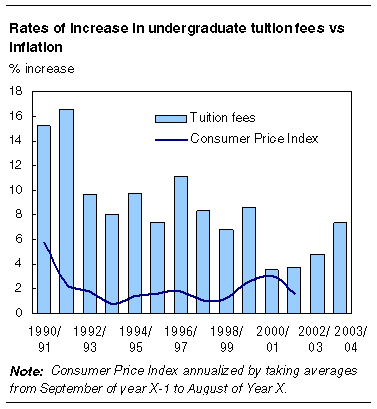
D - so we see that tuition fees CONSISTENTLY exceed the rate of inflation - usually by a wide margin. Young adult students have become the piggy bank that is smashed open for extra change every time the Boomer - backed government feels a bit pinched. THIS is why the Quebec students are protesting - do you really think Charest's tuition hikes is a one-time thing? The students in Quebec saw what happened - and is STILL happening - in the rest of Canada! They've learned.

----------

http://www.statcan.gc.ca/daily-quotidien/100916/dq100916a-eng.htm

http://goodcanadiankid.com/40-000-receipt-tuition-students-paying/

But let’s get to the bottom line: how much tuition should students be paying?  How much should I be paying for my Bachelor of Science?  I think to answer that question, we need to look at the benefits of a university education.  Let’s go back to the metaphor of the business.  When a university educates a student, everybody wins.  I get an education in something specific, and Ontario gets an educated worker.  It might not sound like that big of a deal, but it is projected that in coming years, 7 out of 10 new jobs will require a PSE credential.


----------


D - at some point, accepting a student loan debt to fund a post-secondary education will CEASE TO MAKE SENSE. Do we really want our young adults spending their 20s alternating between unskilled jobs and school (possibly part-time) just so they can get a college diploma/ U degree that is only, via credentialism, "the new high school"?


Additional compulsory fees on the rise

The bundle of services included in additional compulsory fees varies from one institution to the next and can change over time. Typically, it includes fees for athletics, student health services, student associations, as well as other fees that apply to full-time Canadian students.
Starting this year, "partial" compulsory fees such as health plan and dental plan fees that students can choose not to pay if they provide proof of comparable coverage are not included in the calculation of the weighted average for compulsory fees.
Nationally, additional compulsory fees for Canadian undergraduate students increased 7.0% in 2010/2011 compared with the previous year. On average, these students paid $702 in additional compulsory fees in 2010/2011, up from $656 a year earlier.
In 2010/2011, additional compulsory fees for undergraduate students ranged from $407 in New Brunswick to $818 in Alberta. Compulsory fees for graduate students ranged from $234 in Saskatchewan to $984 in Newfoundland and Labrador.
Alberta posted the largest increase in additional compulsory fees for both undergraduate (+$183 or +28.8%) and graduate (+$166 or +24.4%) students. In contrast, compulsory fees decreased in two provinces: New Brunswick (-0.7%) and British Columbia (-12.0%).
Additional compulsory fees are generally excluded from fee regulations and are normally determined in part by provincial departments, institutions and student organizations.


-----------

D - the Quebec students watched what Bob Rae next door in Ontario did in the 1990s. But the tuition hikes NEVER stopped. They continue far about the inflation rate. In fact, considering COMPULSORY FEES also, they are increasing at a rate even higher than tuition charts would suggest!

------------

D - tuition should have REMAINED at c. 10% of operating costs - and gov't contributions should have remained at c. 75%.
Notice anything? The last latest Boomers were born 1964. Allowing for age 21 at graduation, they were all done university as of ... 1985.  For the latest Boomers, gov't contributions had decreased- but tuitions remained steady. The universities took the hit and soaked the loss - until the Boomer were finished. Around 1990, they realized they were neglecting long-term operating costs, and tuitions went up.
AFTER all the Boomers were finished with school - including grad school.
Once again, my "benign neglect hypothesis" holds up stellarly well in explaining Boomer behavior. I don't wish to engage in paranoid "patriarchy theory" conspiracy theories such as feminism espoused. I don't need the Boomers to act collectively like a moustachio-twirling villain for my hypothesis to be valid. I just require that they act selfishly regarding gov't policy of funding and taxation at every stage of their life. And THAT they have demonstrably done!

----------
http://www.ousa.ca/2011/11/24/how-important-are-ancillary-fees-by-chris-martin/ (D - nice summary!)


Even the names associated with these fees paints a picture of relative unimportance; they’re “incidental,” “ancillary” or “miscellaneous.”
Students find this to be an unfortunate reality, since ancillary fees are growing steadily both in terms of cost to students and in their importance to university finance. These fees pay for a wide variety of non-academic services, including health insurance plans, public transit, athletic centres, physical and mental health services, student governments, food banks, campus construction projects and more. After accounting for inflation, ancillary fees per student have grown by six times since 1980, doubling the rate of growth in tuition fees over the same period. This has obviously meant that students are paying more ancillary fees than they ever have before. According to Statistics Canada, Ontario has the second highest average ancillary fees in the country, making our province the most expensive in Canada in which to attend university by nearly $1,000.
Ancillary fee revenue for each full-time equivalent student has increased from approximately $136 in 1979-80 to over $966 in 2009-10, accounting for more than one-seventh of the average student’s bill. In terms of importance to the overall university system, ancillary fee revenue has grown on average from less than one per cent of the operating budget to over six per cent during the same time period. In 2011-12, combined ancillary fee and tuition revenue pushed the overall student contribution to Ontario university operating budgets to 47.96 per cent, just below the government’s contribution of 48 per cent. This means that for the first time, Ontario students are now contributing just as much to the operating costs of universities as the provincial government.


low tuition in Que last vestige of Boomer perks

http://www.theglobeandmail.com/globe-investor/personal-finance/2012-vs-1984-young-adults-really-do-have-it-harder-today/article2425558/


All young adults who think they’re getting a raw deal in today’s economy, let me tell you about how it was back in my day.
In 1984, my final undergraduate year of university, tuition cost more or less $1,000. I earned that much in a summer without breaking a sweat.
When I went looking for a new car in 1986, the average cost was roughly half of what it is now. It was totally affordable.
The average price of a house in Toronto back in 1984 was just over $96,000. I wasn’t buying just then, but it’s worth noting that the average family after-tax income back then was close to $50,000. 
I had to work the Christmas holidays at CP to top up my savings, but I was financially self-sufficient and incurred zero debt.
Today, financial self-sufficiency is impossible without taking breaks from school to work. The Bank of Canada’s handy inflation calculator tells us that my $1,000 tuition back in 1984 would cost $2,028 today if it increased just by the inflation rate annually. But according to Statistics Canada, the latest read on average tuition fees is $5,366.
Canadian Real Estate Association data show the average national price of a home in mid-1984 was $76,214. If houses kept up with inflation – and that would be a pretty good result all on its own – the average house would now cost $154,587. In April, the actual average was $369,677.
-----------
D - and Boomers did not need to riot for that low tuition!
We do. Honestly, the Quebec students are teaching a lesson to all the young today.
Fight for it - or LOSE IT.


Thursday, May 3, 2012

quebec tuition about generational unfairness

http://www.theglobeandmail.com/globe-investor/personal-finance/rob-carrick/young-adults-have-a-right-to-be-up-in-arms/article2420563/


Talk to your kids before you dismiss those Quebec student demonstrators as a bunch of spoiled malcontents.
Even if they’re not on their way into the streets to protest rising university tuitions, young adults have some legitimate grievances about the growing financial divide between them and the older generation.
---------

D - the author lists jobs, real estate -then social programs.

-----------
Think about social programs – Old Age Security is being preserved untouched for today’s seniors by taking benefits away from younger Canadians, and we haven’t yet seen what changes will be required to our health care system as the population ages.
The Quebec demonstrations can’t be dismissed as simply an example of the province’s strong tradition of social activism, and neither are they the actions of selfish youths who aren’t satisfied with the lowest post-secondary tuitions in North America. What’s going on in the province is a fight by twentysomethings to be heard by governments that seem to have little interest in them...
Large student debts would be both tolerable and fair in an economy where graduates can get on with their careers fairly quickly. But, anecdotally at least, this doesn’t seem to be the case...
Some argue that cutting tuition only benefits well-off families because they’re the only ones who can afford to send their kids to university or college. Maybe so, but the net result of tuition costs at current levels is that, according to the Canadian Federation of Students, the average debt for university graduates is almost $27,000.
------

D - yeah, Globe and Mail  yesterday had an article pitching 'fair' or 'income progressive'.
Aid never replaces, $ for $, gov't university funding. The ways aid distorts lower and middle class participation differs - see my earlier blog.
Put another way, Quebec students are defending their privileged status of low tuition - the sole remaining perk that the Baby Boomers took for granted in post-secondary education! Hard to describe this is a sense of entitlement unless you wish to condemn the Boomers universally!
I say privilege in the sense that low tuition is not a constitutional right.
But privileges should sometimes be maintained. 


Wednesday, April 25, 2012

rich jerks not saving enough to retire. what's the prob?

http://www.theglobeandmail.com/report-on-business/canadas-retirement-savings-system-needs-multipronged-boost-report/article2412789/ The report adds to previous research suggesting that Canadians are overly confident about their retirement savings, even though a large percentage of Canadians face a big drop in income once they retire. The stock market has offered limited returns since its peak 12 years ago, hurting the returns of both pension funds and individuals’ savings, the report notes. “However, close to a quarter of households are not on track to generate a retirement income sufficient to maintain their standard of living when they move out of the work force,” the report says. “The share of households that are not on track varies from as little as 4 per cent for the lower income and higher-age cohort to as much as 41 per cent for the higher income and higher-age cohort,” it says. ---------------- D - I don't see the problem. The older Boomers, the ones that had the most benefits from their demographic position, are living high on the hog and not saving. SO WHAT!!! Stop trying to help THEM. They're actually getting what they deserve - FINALLY! Sheesh.